By playing, you allow YouTube (Google) to process data and use cookies. Privacy.
The mechanics of moving together
How fish coordinate their tailbeats to exploit the vortices produced by their neighbors.
This paper identified a schooling strategy where fish synchronize their tailbeats to exploit hydrodynamic advantages, matching behavior previously seen in bio-inspired robots.
 Enlarge figure
When swimming together saves energy
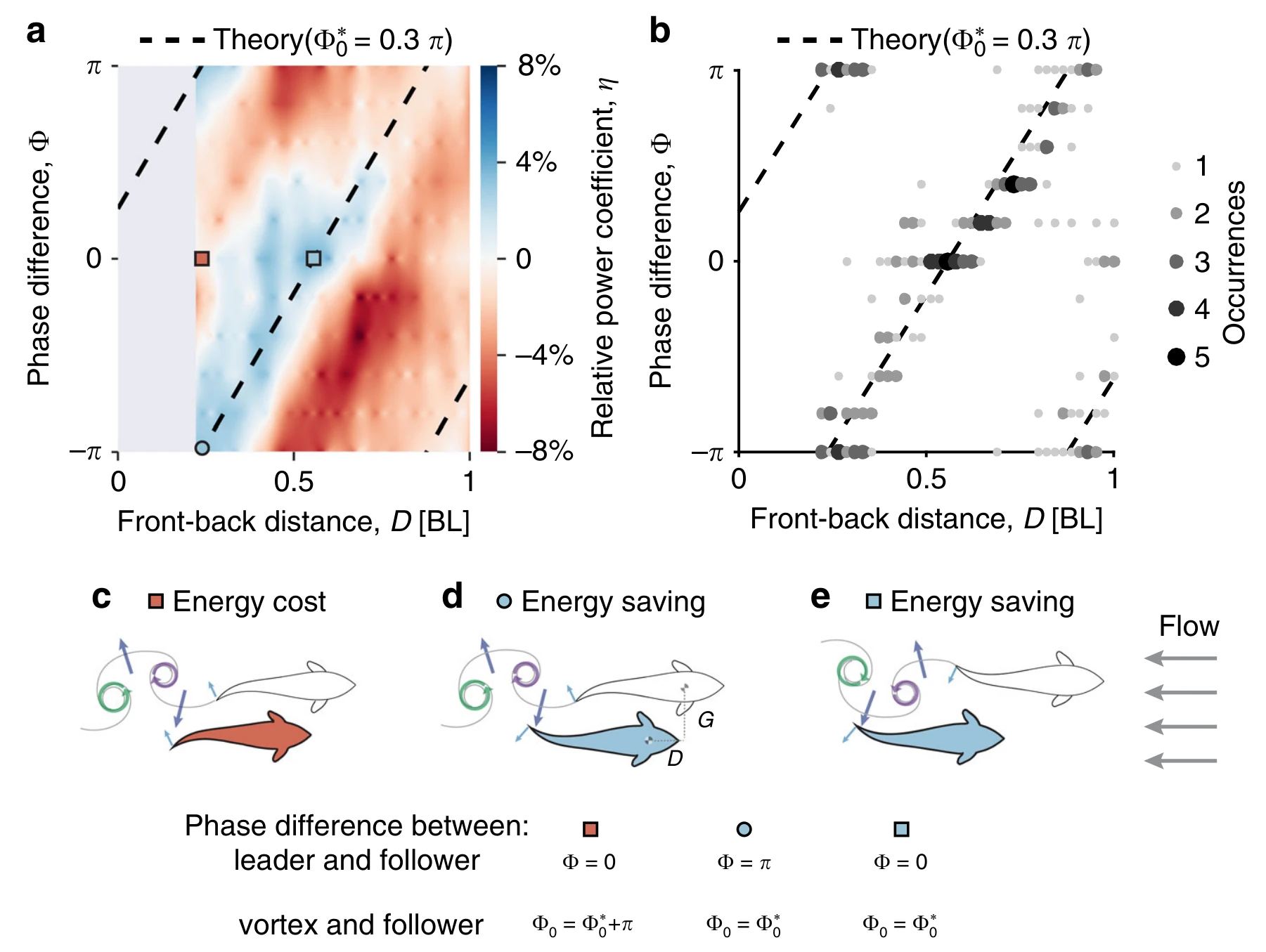
Robotic fish let us measure swimming power directly. The energetic benefit depends on both spacing and tailbeat timing: the follower can move with the flow induced by its neighbor’s vortices, or work against it.
Figure 2 · Li et al., Nature Communications (2020) · CC BY 4.0. Cropped from the published figure.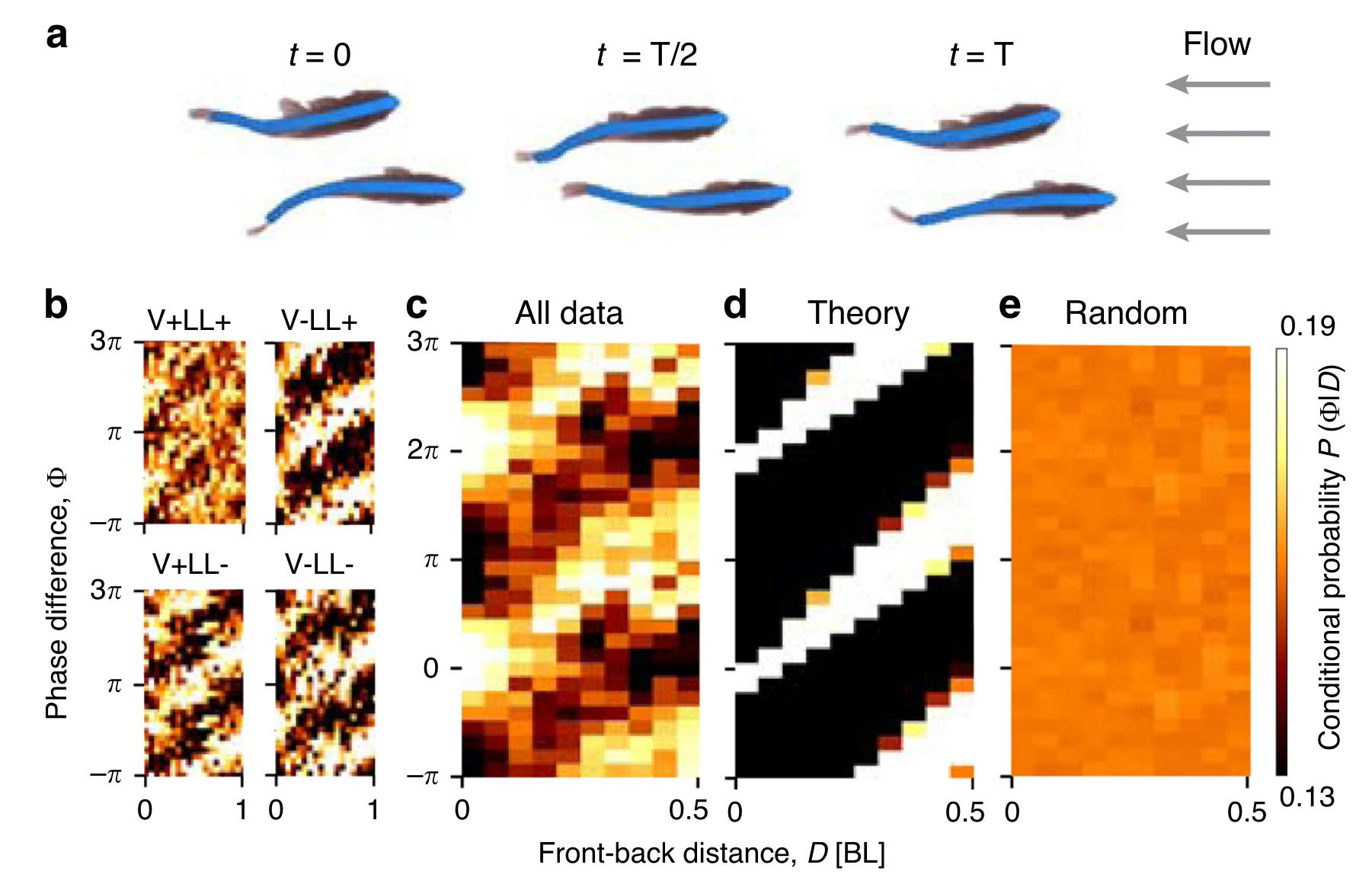
My contribution
I contributed to the analysis pipeline, applying deep learning–based pose estimation to track fish movement and test predictions from robotic models. The findings showed that real fish use similar vortex-phase matching strategies to gain energetic benefits during coordinated swimming.